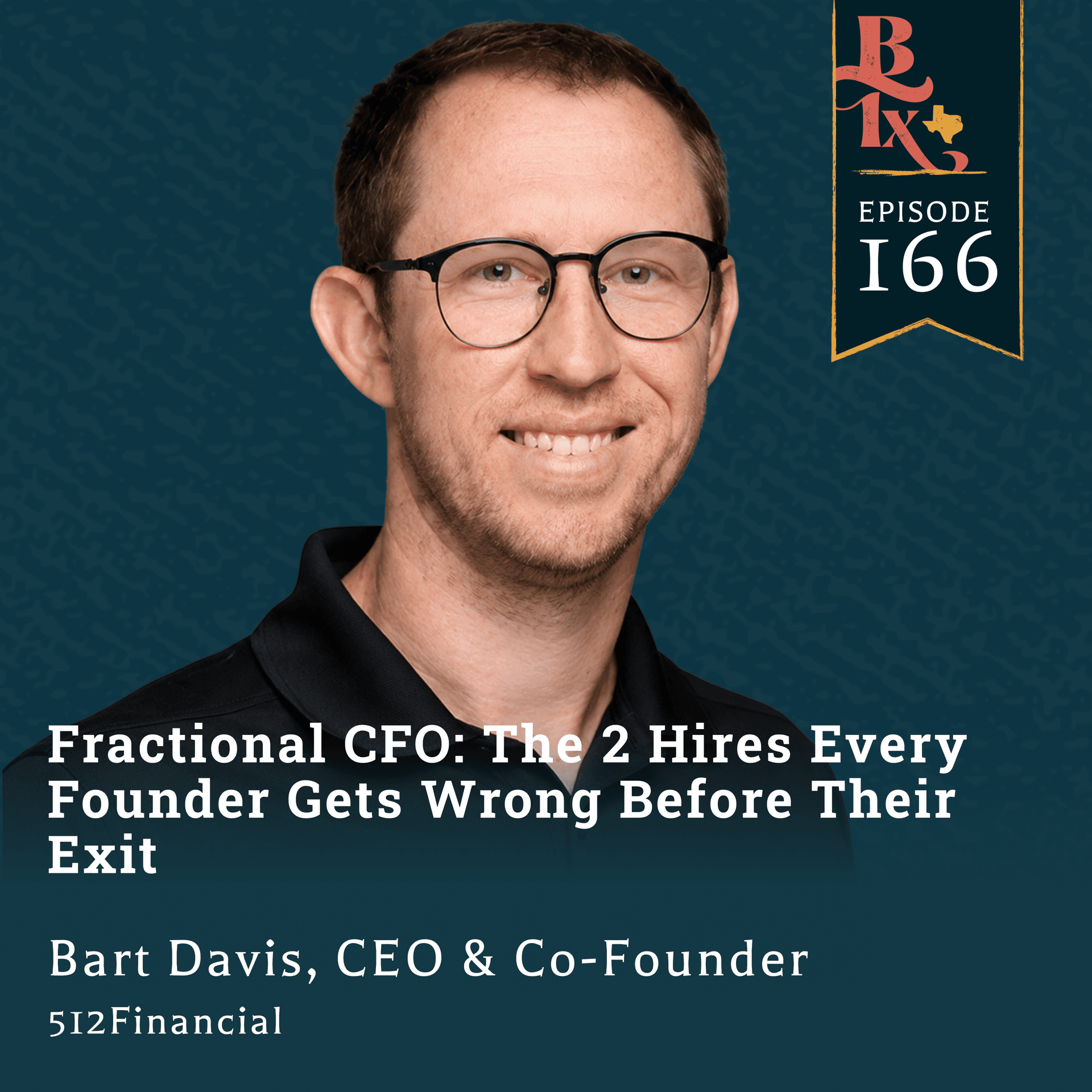
Fractional CFO, now CEO, Bart Davis built 512Financial into a firm serving startups across Austin and the wider Texas startup ecosystem, and he says most founders wait too long to fix their back office. In this conversation he breaks down what a fractional CFO costs (his rule: 2 to 4 percent of revenue), the two hires every founder gets wrong, and whether AI can replace a CFO.
512Financial grew out of a real need. From 2014 to 2021, Bart ran fractional finance for Joel Trammell's portfolio (Packet Design, iGrafx, CM First Group, Novi Labs). After two exits, he saw the same gap across the Austin and San Antonio startup scene and built the firm around it. He walks through why a Fortune 500 CFO and a startup CFO are two different jobs, and why the skills that scale a company from $1M to $15M rarely come from a global finance seat.
He does not hold back on the numbers. One client came in with what he calls "random number generator financial statements" from a bigger outside firm. His fix starts with a simple benchmark: a growing company should spend 2 to 4 percent of revenue on its finance function, which is roughly $250K on a $15M business. He explains why the first two hires a founder should make are a controller and an HR leader, before the next salesperson, and why that order protects your exit.
We also get into the fractional model itself: specialized talent for the price of one generalist, why 512Financial keeps its people on W-2 instead of 1099, and how the HireBetter and Austin People Works acquisitions let the firm add fractional HR and executive retained search. Bart calls it "monetizing churn," placing the full-time CFO once a client outgrows the fractional seat. Then the AI question: can Claude build your financial model? His answer is direct. The output is riddled with errors because the tool makes up its own context when a human does not give it any.
If you are a founder, operator, or investor watching how Texas is building the next wave of companies, this one is worth 25 minutes.
CHAPTERS
00:00 The "random number generator financials" that started it
00:20 Meet Bart Davis, 512Financial (Austin, Texas)
01:11 How a fractional CFO service grew out of a startup portfolio
02:42 Why a startup CFO is nothing like a Fortune 500 CFO
03:42 Buying Austin People Works and HireBetter: fractional HR and retained search
06:22 Why Texas keeps growing while the economy contracts
07:11 San Antonio named the most entrepreneurial city in the country
07:43 When to hire a fractional CFO: finding the inflection point
10:41 The 2 to 4 percent rule: what finance should cost
12:04 Getting grant and public-funding ready before the window opens
12:58 The first two hires every founder gets wrong
13:55 Inside the fractional model: talent for the price of one generalist
15:44 1099 vs W-2: the risk most founders miss
18:47 Can AI replace your CFO?
20:40 Who should call 512 Financial
21:53 Closing
GUEST
Bart Davis, Co-Founder, 512Financial (Five One Two Financial)
Learn more: https://www.512financial.com
The Building Texas Show, hosted by Justin McKenzie, covers the founders, mayors, and innovators driving Texas growth.
Subscribe for new episodes: https://www.youtube.com/@thebuildingtexasshow