

Chamber Vacuum Sealer Selection Factors Outlined for Commercial Packaging Operations
Found this article helpful?
Share it with your network and spread the knowledge!
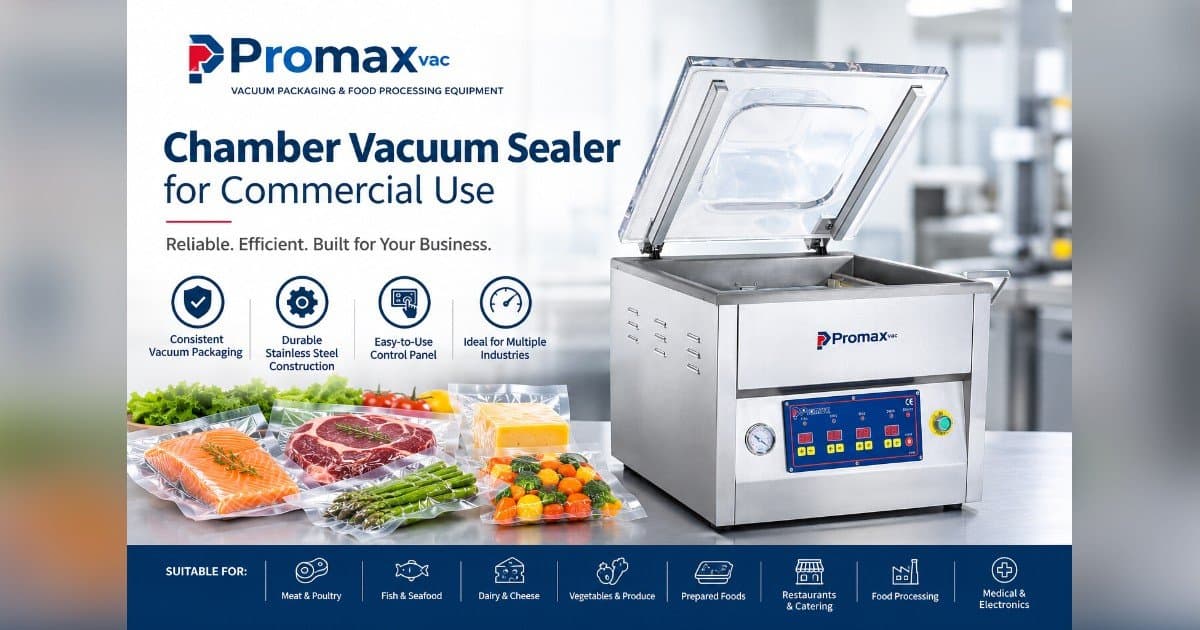
As food processors, distributors, and non-food manufacturers review their packaging lines, the chamber vacuum sealer remains a common choice for operations that need controlled air removal and consistent seals. Promarksvac Corp., a manufacturer of commercial vacuum packaging machines based in Ontario, California, is outlining the factors that typically shape equipment selection in this category.
A chamber vacuum sealer places both the product and its pouch inside a sealed chamber. Air is removed from the entire chamber rather than drawn out of the pouch through a nozzle, and the pouch is heat sealed before the chamber returns to normal pressure. Because pressure inside and outside the pouch stays balanced during the cycle, this method is widely used for products containing liquids or moisture, such as marinated proteins, brined products, and prepared meals.
Chamber machines are built in several formats. Tabletop models suit smaller kitchens, retail meat counters, and lower-volume production. Single-chamber floor models are used where larger products or higher daily volumes are involved. Double-chamber designs allow an operator to load one chamber while the other completes its cycle, which can matter in continuous production settings. Belt-type and nozzle-type machines address other workflows within the broader vacuum packaging equipment category.
Packaging managers comparing commercial vacuum packaging machines generally weigh several practical points: chamber dimensions and seal bar length relative to product and pouch size; pump capacity and cycle time relative to daily volume; compatibility with the pouch material and thickness in use; cleanability and hygiene requirements for the production environment; applicable electrical and sanitation certifications; and availability of spare parts, manuals, and technical support.
Promarksvac Corp. has manufactured vacuum packaging machines and food processing equipment since 1989. The company’s range of industrial vacuum packaging equipment includes tabletop, single-chamber, double-chamber, belt, and nozzle-type machines. Selected systems are equipped with Busch vacuum pumps and are available with applicable UL, ETL, and NSF certifications. The company also offers rollstock packaging machines, MAP tray sealers, commercial shrink tanks, heat sealers, vacuum seal bags, and spare parts. Its processing equipment includes vacuum tumblers, brine injectors, and piston stuffers.
Promarksvac equipment is designed for applications involving meat, poultry, seafood, cheese, and ready-to-eat meals, as well as medical and healthcare packaging. Manufactured in the USA and shipped worldwide, the company is the parent of Foodmax, Profood, and the Promarks Heat Seal Division. Product information, machine manuals, and demonstration videos are available at https://promarksvac.com.
For Texas businesses in food processing, distribution, and manufacturing, these selection factors are critical as they invest in packaging automation to meet demand. The state’s growing food and industrial sectors rely on efficient, reliable packaging to maintain product quality and safety. Promarksvac’s guidance can help Texas operators make informed decisions, potentially reducing downtime and improving throughput. As the company continues to provide equipment and support, its expertise may contribute to the resilience and competitiveness of Texas’s packaging industry.