
USDA Organic Database Analysis Reveals 36% of Listed Operations Are No Longer Certified
Found this article helpful?
Share it with your network and spread the knowledge!
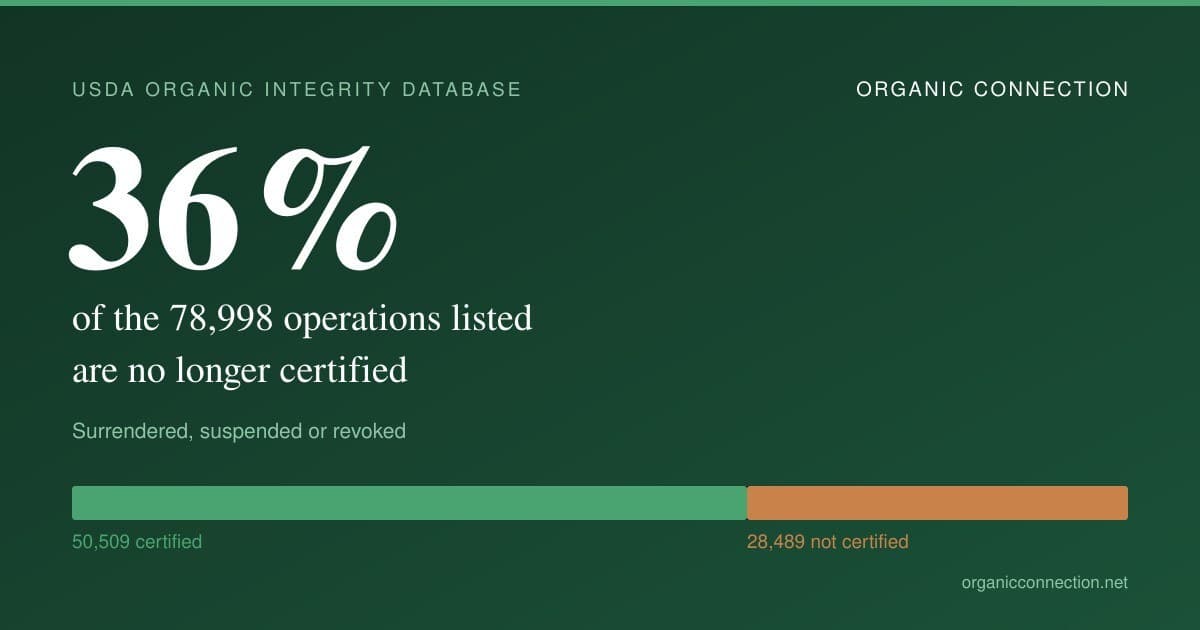
A review of the U.S. Department of Agriculture's public Organic INTEGRITY Database has found that 28,489 of 78,998 listed operations are no longer certified, representing roughly 36 percent of all entries. The analysis, published by product research site Organic Connection, underscores a critical distinction for shoppers and businesses alike: presence in the database does not guarantee active certification.
The Organic INTEGRITY Database is maintained by the USDA's Agricultural Marketing Service and serves as the official record of operations authorized to sell organic products. According to the analysis, only 50,509 of the listed operations hold certified status, while the remainder have surrendered, suspended, or revoked certifications. "A shopper who has been told to look a brand up in the USDA database usually stops at whether the name appears," said James Hardy, editor of Organic Connection. "Appearing is not the answer. More than a third of what is in there is a record of an operation that used to be certified, and the status field is the part that matters."
The second major finding concerns the absence of entire product categories. When Organic Connection cross-referenced brands from its own guides, food and garden companies often matched a certified legal entity, but beauty, personal care, and pet grooming brands largely did not. This is not due to non-compliance but to the structure of the National Organic Program, which certifies agricultural operations under four scopes: crops, livestock, handling, and wild crops. A cosmetics company that uses certified organic ingredients is not itself required to be certified, so it has no database entry. "The absence of a shampoo brand from the USDA database is not evidence that its organic claim is false," Hardy said. "It usually means the certification sits with the farm that grew the ingredient and the handler that processed it, several steps upstream from the bottle."
For personal care products, cosmetic-specific standards such as COSMOS and Ecocert set minimum organic content percentages and restrict synthetics. These certifications are more relevant for finished formulations. The distinction is important because U.S. cosmetic labeling allows terms like "natural" and "clean" without regulatory definition; the FDA notes it does not have a definition for "natural" in cosmetics.
Pet grooming products fall into an even broader gap. They are not cosmetics under the Federal Food, Drug, and Cosmetic Act, which defines a cosmetic by application to the human body. They become drugs only when a label makes a therapeutic claim. This leaves descriptive language on pet shampoo subject to less scrutiny than on human products, though USDA organic certification remains available because it is an agricultural standard.
For Texas businesses in the organic sector, these findings have significant implications. Retailers and brands must ensure their marketing accurately reflects certification status and understand that absence from the USDA database does not imply fraud. Consumers should check the status field, look for cosmetic-specific certifications on beauty and pet products, and recognize that "made with organic ingredients" is a weaker claim than "certified organic." As the organic market continues to grow, such clarity will be essential for maintaining trust and informed purchasing decisions.