

McKinney's idhubs Challenges Best-of-Breed Software Model with Unified AI Platform
Found this article helpful?
Share it with your network and spread the knowledge!
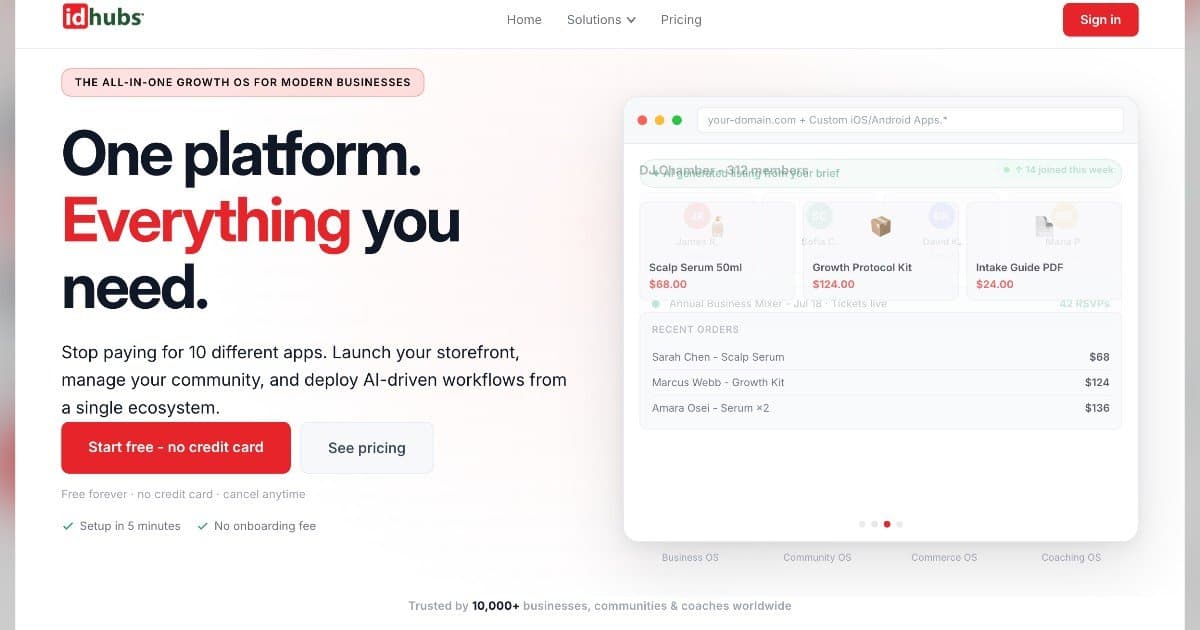
For years, businesses have been told to buy the best tool for each job and stitch them together. But idhubs, a McKinney-based technology company, says that approach is now a liability, especially as artificial intelligence becomes capable of executing complex workflows. In an interview with The Building Texas Show, Founder and CEO/CTO Rojit Sorokhaibam and Chief Growth Officer Brandon Fears explained why they believe the integration model is broken and how their platform aims to replace it.
The problem, according to Fears, is chaos that business owners never chose. A company with fewer than 200 employees typically runs about 42 separate applications. A manager trying to convert a prospect, send an onboarding agreement, bill a deposit, and assign a kickoff task must touch five different apps, each with its own login and data silo. "Most of the day goes to running software instead of running the business," Fears said. Worse, those systems often hold slightly different versions of the same data, a gap the industry sold as "best of breed."
Sorokhaibam argues that AI exposes the fatal flaw in this model. When AI was just a chatbot, siloed data was an annoyance. Now that AI is becoming an agent that executes multi-step work, siloed data is a wall. He calls this "context blindness." An AI agent cannot intelligently complete a workflow if it must reach across five databases connected by brittle webhooks. "True intelligence needs one data foundation," Sorokhaibam said, "and you cannot bolt that on after the fact."
To illustrate, Sorokhaibam described a customer success scenario. In a fragmented stack, a complaint posted in a community forum requires a support agent to manually read it, open the CRM, find the account, check billing, and draft a reply. In idhubs, the AI agent natively reads the post, pulls the user's billing history from the unified invoicing module, identifies a double-charge, auto-drafts a credit memo, and routes it to a manager for one-click approval—all without human copying and pasting.
That capability stems from idhubs' architecture: one natively unified operating system that combines CRM, e-commerce, community, and invoicing on a single shared data layer. The company also offers a white-label community and social commerce layer, allowing organizations to own their audience and data rather than renting it on third-party platforms. Because community data lives beside CRM and commerce data, a discussion can become a transaction or a support ticket without leaving the branded environment.
Security is a key concern for any CIO considering consolidation. Sorokhaibam explained that idhubs runs a permissioned, private Hyperledger Fabric network underneath the platform. Unlike public blockchains, Fabric uses channels and private data collections, so sensitive records are visible only to cryptographically authorized nodes. Heavy files are stored off-chain, while the ledger anchors state changes and audit trails. This provides enterprise-grade auditability and data sovereignty without the latency or infrastructure costs of public chains.
The market opportunity is substantial. idhubs cites a total addressable market of roughly $158 billion and has acquired more than 50,000 registered users organically, with no paid marketing. The leadership team includes Sorokhaibam, a three-time exited CTO; Fears, who has launched more than $2 billion in products; and COO Sav, a 30-year operations leader. Advisors include Grant Johnson, former CEO of a NASDAQ-listed company, and Craig Kaufman of Kaufman Bros.
Pricing is designed to avoid the per-seat model that punishes growing teams. Instead, idhubs charges a flat, predictable annual rate based on organizational capacity and transactional volume, with no hidden integration fees or per-API charges. Migration, often a barrier to switching, is addressed through automated pipelines for major incumbents like HubSpot, QuickBooks, Salesforce, and Slack, with parallel environments and automatic data mapping to achieve time-to-value in days.
Competitors like Zoho, Odoo, and HubSpot offer unified suites, but Sorokhaibam contends they are still built as separate apps glued together, with fragmented data layers underneath. "We are natively unified from the ground up on a single data layer," he said, adding that Hyperledger security is enterprise-grade out of the box. For more information, visit idhubs.
If the idhubs model gains traction, the ripple effect could be significant. Sorokhaibam envisions software becoming a silent partner, eliminating the integration tax and freeing human capital for strategy instead of reconciliation. For member organizations, it could turn a siloed directory into a connected economic ecosystem. As Fears put it, "The fix was never one more tool or one more integration. It was always one secure, unified platform." That shift, if it happens, would not only simplify operations for Texas businesses but could redefine how companies of all sizes adopt AI and manage data in an increasingly automated world.