
Judge Steve Snell Outlines Williamson County's Growth Strategy as Population Set to Double by 2055
Found this article helpful?
Share it with your network and spread the knowledge!
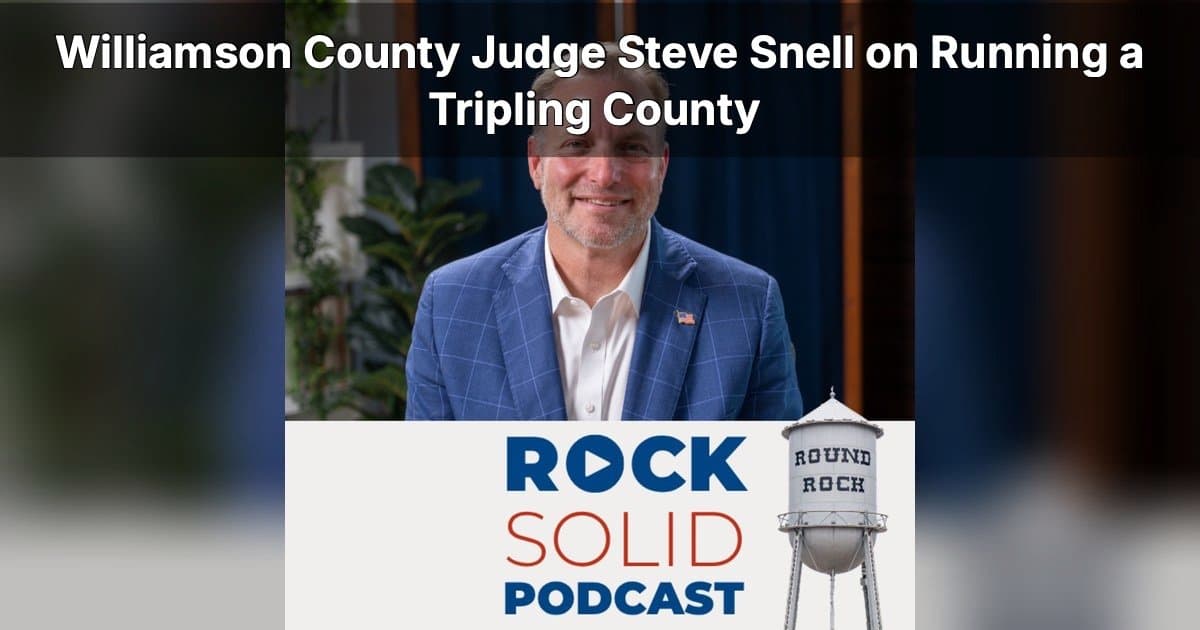
Williamson County, home to roughly 760,000 residents today, is projected to reach 1.6 million by 2055 and 3 million by the end of the century—a doubling that will reshape the region's infrastructure, economy, and quality of life. In a new episode of the Rock Solid: Round Rock Business Leaders Podcast, County Judge Steve Snell tells host Bryan Eisenberg how he is steering that growth, likening his role to that of a CEO and emergency manager rather than a traditional courtroom judge. The episode, "Judge Steve Snell | Williamson County's Explosive Growth," published September 15, 2026, offers a window into the decisions that will determine whether the county can absorb its coming population boom.
Snell's background as a 31-year public education leader, including roles in Hutto ISD and as superintendent of Liberty Hill ISD, informs his approach. He oversees roughly 30 to 35 departments, from fleet services and animal shelters to the juvenile justice center and Sheriff's Office. That breadth means balancing immediate needs—like emergency response after Williamson County's historic July floods—with long-range transportation, water, and energy planning across cities including Round Rock, Georgetown, Cedar Park, Liberty Hill, Florence, and Jarrell.
The county's economic development wins are central to its ability to fund that growth. Snell cites Dell, Samsung, Compal, Apple, Firefly, Kalahari, Nebraska Furniture Mart, and the incoming Scheels in Cedar Park as anchors of a diversifying tax base. He also points to Williamson County's designation as a spaceport in partnership with the City of Cedar Park, its position between Fort Hood and joint commands in downtown Austin, and Firefly Aerospace as the current anchor of a rapidly expanding space sector. Those assets could make the county a hub for aerospace and defense innovation, attracting high-wage jobs and supply-chain investment.
Growth also brings friction. Snell describes the challenge of unincorporated neighborhoods and municipal utility districts, where new development can overwhelm old roads. "When you build 1,000 homes next to an old two-lane road and all the construction trucks tear it up, we need to come and fix that for mobility and safety, or we need to expand it," he tells Eisenberg. That practical view reflects a broader philosophy: "at the end of the day, it's not about me. It's about service and it's about Williamson County."
For businesses and residents, the implications are significant. The county's ability to coordinate transportation, water, and energy will determine whether it can sustain its economic momentum. Snell highlights trade education, workforce development, veteran employment as service members transition out of Fort Hood, and entrepreneurship classes in Liberty Hill high schools, where a chamber president now teaches students. He praises Round Rock ISD, Leander ISD, Cedar Park's Plug and Play, and partnerships with Precinct 2 Commissioner Cynthia Long on land acquisitions for future schools and parkland.
As Williamson County approaches a population of 1.6 million by 2055, Snell's CEO-style leadership—complete with a three-ring binder tabbed with budget lines, policies, and responsibilities—will be tested. The decisions made today on infrastructure, education, and economic development will shape whether the county remains one of America's fastest-growing success stories or becomes a cautionary tale of unchecked growth.