

Huawei's Hi-ONE Optical Engine Set to Transform AI Computing Infrastructure
Found this article helpful?
Share it with your network and spread the knowledge!
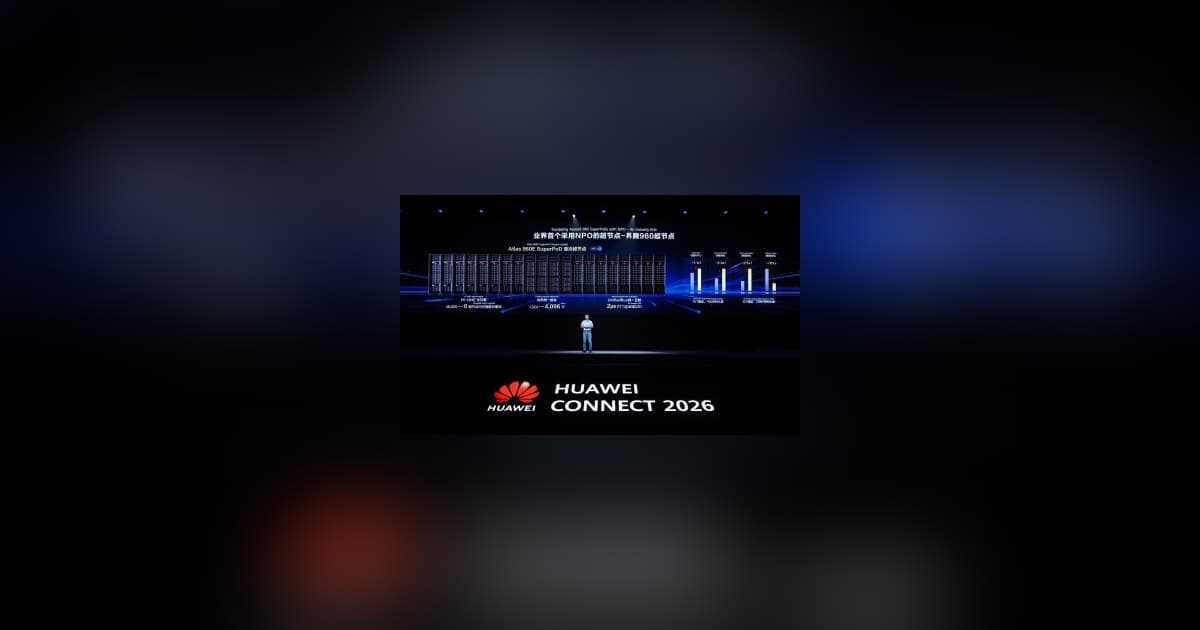
At HUAWEI CONNECT 2026, Huawei unveiled the industry's first near-packaged optics (NPO) optical engine with a built-in light source, named Hi-ONE. The engine offers a total capacity of 7.2 TB/s and is the first such product to enter mass production. This launch marks a significant step in high-speed optical interconnect technology, with potential ripple effects across the AI computing industry and global data center supply chains, including in Texas, where many technology companies and data centers operate.
Hi-ONE has already been deployed in Huawei's Ascend 960 SuperPoD, which uses a "UnifiedBus plus Hi-ONE" architecture. According to Huawei, this integration has reduced the number of 800G optical modules within the SuperPoD by 48,000, significantly lowering system power consumption and enhancing reliability. For Texas businesses involved in AI, cloud computing, and data center operations, such advancements could lead to more efficient and cost-effective infrastructure, potentially lowering operational costs and enabling more powerful AI models.
The NPO technology path balances innovation with ecosystem continuity. NPO keeps optical engines close to switching chips, shortening the distance between optical and electrical signals while maintaining the independence of optical engines. This maximizes the continuity of customer usage habits and industry ecosystems. Huawei's Hi-ONE is the NPO product with the highest transmission capacity in the industry and the first to adopt a built-in light source architecture. The company achieved breakthroughs in bandwidth, reliability, power consumption, and latency through self-developed technologies.
Hi-ONE is the first optical engine to integrate 36 channels of optical transceivers, reducing discrete components and lowering failure rates at the source. It integrates compound optical chips, silicon photonic chips, and optoelectronic RF chips. Through a balanced design of optical, mechanical, electrical, magnetic, and thermal elements, it supports 7.2 TB/s on a single engine, improving overall reliability by 10 times. This ensures stable operation for long-duration training tasks, which is critical for AI research and deployment.
With a linear direct-drive architecture, Hi-ONE eliminates the need for high-power oDSP chips, cutting power consumption by approximately 66% and latency by about 90%. This reduces energy costs and boosts communications efficiency. For Texas, a state with a growing technology sector and significant energy consumption from data centers, such efficiency gains could support sustainability goals and reduce strain on power grids.
Huawei has also advanced NPO standards and ecosystem development. In May 2026, the standard proposal for a "12.8 TB/s NPO Module," jointly submitted by the China Academy of Information and Communications Technology (CAICT), Huawei, and other companies, was initiated by the Optical Internetworking Forum (OIF), with support from more than 40 global industry chain vendors. The OIF plays a key role as a core standards developer and interoperability promoter in the optical communications industry, particularly in high-speed optical modules and data center interconnect. This broad support indicates industry consensus and could accelerate adoption, benefiting Texas companies that rely on global standards for interoperability.
From technological breakthroughs to product application, and from international standards to ecosystem development, Huawei is driving NPO from industry consensus to large-scale commercial use. The implications for Texas are notable: as a hub for semiconductor manufacturing, data centers, and AI innovation, the state's businesses could leverage these advancements to enhance their competitive edge. Improved optical interconnect technology can enable faster data processing, lower energy costs, and more reliable AI infrastructure, which are essential for industries ranging from healthcare to finance. As NPO technology matures, it may also spur new investment and collaboration opportunities within Texas's tech ecosystem.