

Did You Know? One Texas Pioneer Helped Build a County, Defend a Republic, and Shape East Texas
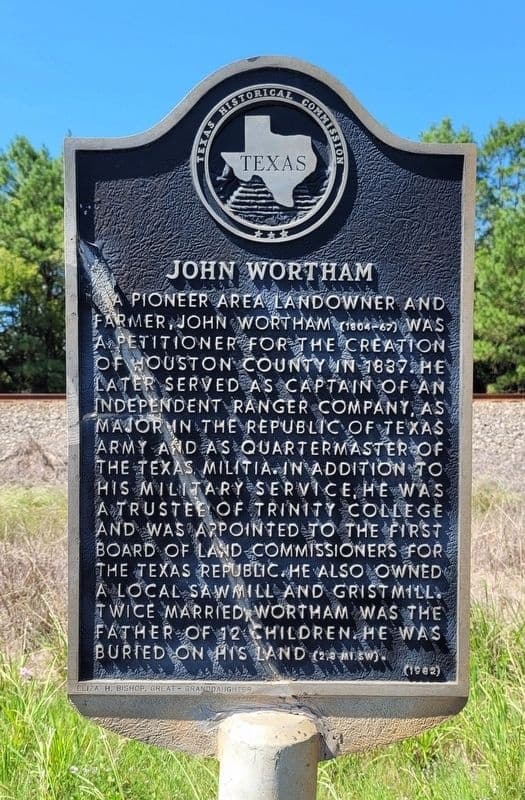
Did You Know? Texas Historical Marker #11062
When we think about the people who built Texas, names like Sam Houston and Stephen F. Austin often come to mind. But scattered across the state are stories of lesser-known pioneers whose contributions helped shape the Texas we know today.
One of those individuals was John Wortham.
Born in 1804, Wortham arrived in Texas during a time when the region was still a rugged frontier. As a landowner and farmer in what would become Houston County, he played a direct role in establishing local government by petitioning for the creation of Houston County in 1837, just one year after Texas won its independence from Mexico.
But Wortham's impact extended far beyond agriculture.
During the early years of the Republic of Texas, he served as captain of an independent ranger company, rose to the rank of major in the Republic of Texas Army, and later served as quartermaster of the Texas Militia. At a time when Texas was still defining its borders and defending its settlements, leaders like Wortham helped provide both security and stability.
His contributions weren't limited to military service. Wortham was appointed to the first Board of Land Commissioners for the Republic of Texas, helping manage one of the young republic's most valuable assets—its land. He also served as a trustee of Trinity College and operated both a sawmill and gristmill, supporting the economic growth of the region.
In his personal life, Wortham was twice married and became the father of twelve children, leaving behind a legacy that extended well beyond his public service.
Today, travelers can find Texas Historical Marker No. 11062 near Crockett in Houston County, commemorating a man whose life reflected the spirit of the Texas frontier: entrepreneur, soldier, civic leader, educator, and builder of community.
The next time you're driving through East Texas, remember that some of the state's most influential builders aren't always found in history textbooks. Sometimes their stories are waiting beside a rural highway, preserved on a historical marker and remembered through the communities they helped create.