Did You Know? Longhorn Caverns State Park was a nightclub?
Longhorn Caverns is one of those unmistakable Texas stories where natural wonder and human effort come together to define a place. Most visitors know the cavern for its dramatic limestone rooms, ancient fossils, and frontier lore — but the reason we can walk through them today is because of a remarkable chapter in Texas history tied to the Civilian Conservation Corps, one of the most successful work programs of the New Deal era.
When Longhorn Caverns opened to the public in 1932, the underground labyrinth was raw, muddy, and largely inaccessible. Trails were informal, lighting was nonexistent, and vast stretches of the cave were buried under silt and debris. The State of Texas had acquired the land just as the Great Depression was deepening, and jobs were scarce for young people and families across the country. That’s where the Civilian Conservation Corps (CCC) came in.
From 1934 to 1942, Company 854 of the CCC worked at Longhorn Caverns State Park, transforming the space into something that could safely welcome the public. These weren’t simply landscaping crews — they were a specially organized workforce of young men sent from all over Texas and the South to learn skills, earn wages, and help build America’s public lands. Over years of manual labor, using hand tools and ingenuity, the CCC carved out walkways, staircases, and drainage systems so visitors could explore without getting lost in rubble;
removed millions of cubic yards of debris, mud, and guano that filled the cave from ancient river activity;
installed lighting systems deep inside the cavern, allowing guided tours to safely light the way;
and even used excavated rock to help build Park Road 4, the scenic entrance to the park itself.
This work wasn’t just construction — it was the creation of a lasting public treasure. The same stone steps, paths, and lights that guide modern explorers began as the sweat and strategy of CCC crews nearly a century ago. Their effort embodies the Austin-to-Burnet spirit of resilience we celebrate on The Building Texas Show: when Texans need work, purpose, and pride, they build — literally — and they leave something beautiful for generations to come.
So the next time you walk down into Longhorn Caverns, remember this: those stairs weren’t just cut into rock. They were carved into the fabric of Texas history by young men whose labor gave us access to one of the Hill Country’s toughest and oldest storytellers — the cavern itself.
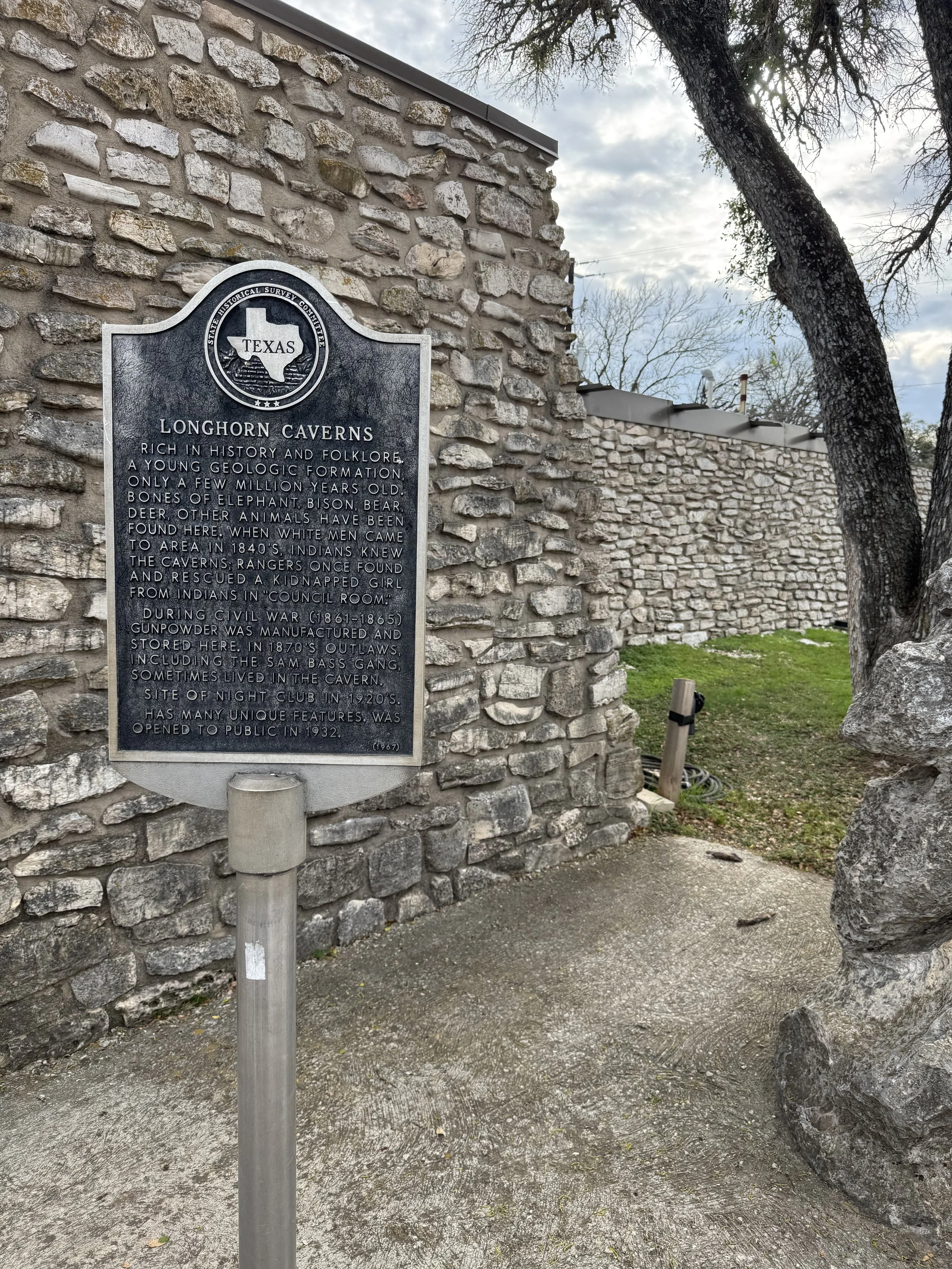
Here is the exact wording from Texas Historical Marker #9724 as it appears on the plaque:
Rich in history and folklore. A young geologic formation, only a few million years old. Bones of elephant, bison, bear, deer, other animals have been found here.
When white men came to the area in 1840’s, Indians knew the caverns; Rangers once found and rescued a kidnapped girl from Indians in “Council Room.”
During Civil War (1861-1865) gunpowder was manufactured and stored here. In 1870’s outlaws, including the Sam Bass gang, sometimes lived in the cavern.
Site of night club in 1920’s.
Has many unique features.
Was opened to public in 1932.