Did You Know? | The Granite That Built the Texas State Capitol Passed Through Williamson County
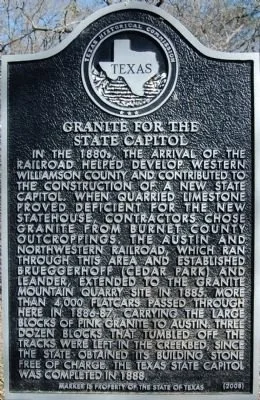
Texas history is full of hidden stories tucked behind familiar landmarks — and Historical Marker 14310 reveals one of the most important. The iconic pink granite Texas State Capitol, completed in 1888, owes its existence to a surprising chain of events that unfolded across western Williamson County.
When Limestone Failed, Granite Stepped In
In the early 1880s, Texas was constructing a grand new statehouse in Austin. The original plan called for local limestone, but the material didn’t hold up to the architectural demands. Builders needed something stronger — and Texas had it.
Just northwest, in Burnet County, massive outcroppings of durable sunset-colored granite at Granite Mountain offered the perfect solution.
A Railroad That Built More Than Towns
To move the enormous stone blocks, the Austin and Northwestern Railroad extended its line directly to the quarry in 1885. This expansion helped create and grow communities like Brueggerhoff (later Cedar Park) and Leander, transforming the region’s economic trajectory.
Between 1886 and 1887 alone, more than 4,000 flatcars rumbled through this corridor, each loaded with heavy granite blocks bound for the Capitol site in Austin.
The Mishaps Still Visible Today
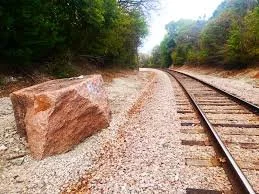
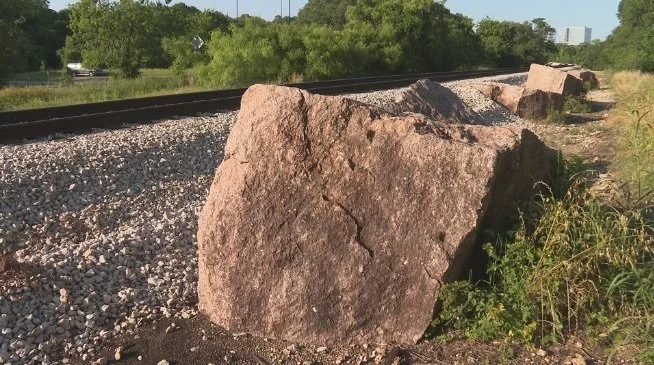
A lesser-known twist: not every shipment made it to the Capitol grounds. Rough terrain and early rail technology led to multiple derailments. Three dozen blocks of granite tumbled off the cars and landed in nearby creekbeds.
Because the State of Texas received the granite free of charge, the abandoned blocks were simply left behind — and some of them are reportedly still visible today, silent relics of one of the largest public works projects of the 19th century.
A Capitol Built on Texas Stone
By 1888, the project was complete. The Texas State Capitol — now a National Historic Landmark — stands proudly in downtown Austin, its distinct pink hue forever tied to Burnet County’s geology and the railroad lines that cut across Williamson County more than a century ago.